The Two Trees of Valinor


This is a small painting that I completed recently, inspired by the Two Trees of Valinor as described in the first book of the Silmarillion by J.R.R. Tolkien:

And as they watched, upon the mound there came forth two slender shoots; and silence was over all the world in that hour, nor was there any other sound save the chanting of Yavanna. Under her song the saplings grew and became fair and tail, and came to flower; and thus there awoke in the world the Two Trees of Valinor. Of all things which Yavanna made they have most renown, and about their fate all the tales of the Elder Days are woven.

The one had leaves of dark green that beneath were as shining silver, and from each of his countless flowers a dew of silver light was ever falling, and the earth beneath was dappled with the shadow of his fluttering leaves. The other bore leaves of a young green like the new-opened beech; their edges were of glittering gold. Flowers swung upon her branches in clusters of yellow flame, formed each to a glowing horn that spilled a golden rain upon the ground; and from the blossom of that tree there came forth warmth and a great light. Telperion the one was called in Valinor, and Silpion, and Ninquelote, and many other names; but Laurelin the other was, and Malinalda, and Culurien, and many names in song beside.

In seven hours the glory of each tree waxed to full and waned again to naught; and each awoke once more to life an hour before the other ceased to shine. Thus in Valinor twice every day there came a gentle hour of softer light when both trees were faint and their gold and silver beams were mingled. Telperion was the elder of the trees and came first to full stature and to bloom; and that first hour in which he shone, the white glimmer of a silver dawn, the Valar reckoned not into the tale of hours, but named it the Opening Hour, and counted from it the ages of their reign in Valinor.
Yavanna was one of the Valar-- essentially a sort of angel who worked to create the world that Iluvatar decreed-- and was responsible for all things that grew on Arda (the world, which Middle-Earth is a part of).

Telperion and Larelin were the only light besides the stars at this time. The Silmarils, gems of great beauty that played a huge role in the first few ages of Ea (the universe) (and which gave their name to The Silmarillion), were created from their dew.

Melkor, the main evil dude and Saruon's overlord-- grew jealous of the trees and their beauty. He wounded them and sent the 'gloom-weaver' Ungoliant (a giant spider, the great-great-great-something-grandmother of Shelob, of Lord of the Rings fame) to poison the trees and drain their sap.

The Sun and the Moon were created from the leaves of Larelin and Telperion, respectively. Other important items from LotR, including the White Tree of Gondor and Galadriel's phial of light which she gives Frodo, also come from these trees.

I had to use a lot of parenthesis to explain all of that... which is just proof that Tolkien truly was a genius subcreator. (That and that the depth of his work can get confusing). Everything had its own place in the story. The Silmarillion can be difficult to read at times, since it feels like a cross between an old mythology book and a dry history text-- a very different style from the Lord of the Rings trilogy--, but the stories are amazing. It is well worth reading! 

I thought I'd share some behind-the-scenes pictures for this painting, not because I'm a great artist whose technique you should copy (seriously, I broke so many "rules" while making this painting) but because I always enjoy seeing how other people approach drawing and you just might like seeing my process.


I began with a light pencil sketch. I didn't use any references-- which is usually a bad thing for me-- but in this case I did not want realistic trees, and so I let my stylistic tendencies go crazy.

Yes, the celtic knotwork in the tree branches was done entirely freehand and based off of nothing but a sharpie drawing I did in an old sketchbook.

I thought at first that I would simply outline the trees in a Chinese calligraphy style... but I've never managed to actually just make a simple picture. I always make things crazy complicated!


The outlining was done in gouache (rhymes with squash, yes, it's very fun to say) mixed with only a tad of water. I used the same brown mixed with blue, for Telperion, and yellow, for Larelin. Gouache (which is really difficult to spell and the spellchecker hates me at the moment) is a very interesting paint, and it feels like a mix between watercolor and acrylics. I totally don't know the proper way to use it.

At this point I thought I'd try painting the "mingling of lights" that occurred twice each day in Arda-- which is an amazing idea and is so much more beautiful inside my head than on paper.

The purple and yellow lights were originally done in watercolor but I went back over them with a very watered-down gouache. Normally you do the background first, people, it makes life easier...


At this point I went into full-out painting mode and really regretted doing this on regular thin journal paper.

You might notice some of the details here-- there are a lot of symbolic things in this picture. 

Firstly, the Celtic knotwork. Aside from being pretty, it's inspired by the interlacing decoration drawn by the Norse and Celtic people. Tolkien was greatly inspired by their mythology and the Two Trees remind me of the mythological tree Yggdrasil. 

Each tree intertwines around either the Sun or the Moon and the white flowers are inspired by the White Tree of Gondor. I also painted things like the rain of light and the speckled ground.

On the bottom are two leaves (which I tried to draw as Tolkien described for each tree) along with the three Silmarils. I know they don't look like real gems, but I copied Tolkien's heraldic design for them.

The Silmarils, drawn by J.R.R. Tolkien   (image via)

Everything was done in gouache, either very very watered down, like watercolor, or very thick and opaque. I don't know if you can see it but there are many places with decorative opaque white dots...

Gouache works really well in a calligraphy dip pen, by the way. And the Tengwar writing at the top is the English mode and merely reads "Trees of Valinor."


And because I like angled pictures:


Voila, there you go, I did a painting of the Two Trees of Valinor and it turned out nothing like what it appeared in my mind! I like the stylistic work, but I may try my hand at something more realistic...

Celtic Knotwork, Not a Tutorial


As I've gotten better and better at drawing Celtic knotwork, several people have asked me to make a tutorial. 

The truth of the matter is that I still don't know enough to feel qualified to teach someone how to draw knotwork. Much of what I know is just a gut instinct that comes from drawing frequently and paying close attention to the designs I see other artists creating. (Our library doesn't have any helpful books and I've had a hard time finding good comprehensive tutorials online). I've been able to teach some of these techniques to friends, but only with the ability to see where and why I can't explain things well enough for it to make sense the first twenty tries!

Hence the reason why this video is not a tutorial. I just doodled a bunch of Celtic knotwork in basic squares using different grids and set-ups (filling in irregular shapes is a HEADACHE even if it looks pretty!). If you've attempted drawing knots before and understand the very basic ideas, then this will be super helpful. If not... well, you probably won't learn much but you get to watch me draw. Lucky you, right?

Sir Gawain and the Green Knight manuscript.
From Wikipedia.
What do Celtic knots have to do with Tolkien? This month's posts are, after all, supposed to be Tolkien-themed. So I'm going to grasp at some straws here to tie this just-because video back to Tolkien. :)

Tolkien was a scholar of linguistics, particularly languages from the early days of England. He translated many texts (one of my favorites is Sir Gawain and the Green Knight) and would of course have seen some illuminated manuscripts.

Interlacing (the technical name for knotwork) is a very common design in illuminated manuscripts. Many people have heard of the Book of Kells, a book of the Gospels heavily decorated with knotwork. This is one of the most important books in the history of modern knotwork, since most of the designs we commonly see are actually copies of the knots drawn by monks in ninth-century Iona.
The Book of Kells contains a massive amount of intricate decoration, and no two designs are exactly alike. And it was all drawn completely by hand.

   
(images via wikipedia)
Norse wood carving with interlacing.
Not sure if it's authentic, but this is the idea
image via


Somewhere in the past twelve hundred years, the techniques for drawing knotwork-- the techniques used by Vikings on their ships, monks in their books, and sculptors on the famous Irish crosses-- were lost. For a long time people were only able to copy ancient designs. Many people in the past couple hundred years developed ways of designing new knots, but most designs you see these days outside of certain artsits' work is very similar to the knots in illuminated manuscripts. (I'd cite a reference for that only I don't feel like finding the file for my old research paper).


Tolkien also loved Norse mythology; in fact, he created Lord of the Rings as a way to fill a void in English literature. England had no mythology or legends of its own, unless you count a few tales like Beowulf and later stories of King Arthur (many of which were written in France!). Norse mythology and literature is very present in Tolkien's world, particularly in the civilizations of Rohan and Gondor.

(For instance, only last week I learned that King Theoden's famous lines "Where is the horse and the rider? Where is the horn that was blowing? Where helm and the hauberk, and the bright hair flowing?" is a sort of rip-off of the Old English poem The Wanderer.)

In a letter, Tolkien explained his idea...
"Do not laugh! But once upon a time (my crest has long since fallen) I had a mind to make a body of more or less connected legend, ranging from the large and cosmogonic to the level of romantic fairy-story--the larger founded on the lesser in contact with the earth, the lesser drawing splendour from the vast backcloths--which I could dedicate simply: to England; to my country. It should assess the tone and quality that I desired, somewhat cool and clear, be redolent of our 'air' (the clime and soil of the North West, meaning Britain and the hither parts of Europe; not Italy or the Aegean, still less the East), and, while possessing (if I could achieve it) the fair elusive beauty which some call Celtic (though it is rarely found in genuine ancient Celtic things), it should be 'high', purged of the gross, and fit for the more adult mind of a land long steeped in poetry. I would draw some of the great tales in fullness, and leave many only placed in the scheme, and sketched. The cycles should be linked to a majestic whole, and yet leave scope for other minds and hands, wielding paint and music and drama. Absurd." - J.R.R. Tolkien
I don't think he was so absurd. Of course no single man could do that-- legends take generations and hundreds of nameless taleweavers-- but Tolkien's efforts have had an indelible mark on fantasy stories.

So that's how I'm relating Celtic knotwork to Tolkien.

Plus the talented designers who worked on the LotR filmes obviously used knotwork in the beautiful sets and little details everywhere.

image via
image via
image via

image via
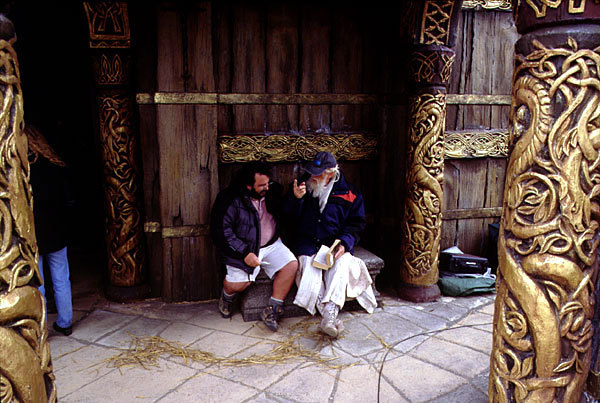
Peter Jackson and Ian McKellan at the Edoras set
image via

Justin Gerard: Illustrations and Interview

Glorfindel and the Balrog by Justin Gerard

I'm not sure how I found Justin Gerard's blog-- no doubt I just happened upon it during one of those must-click-every-link-on-every-blog days-- but I fell in love with his artwork straight away. His sketches and paintings feature monsters, warriors, vast landscapes, and beautiful colors. The style is really neat-- a mix of unleashed imagination coupled with realism-- Best of all, he drew pictures of some of my all-time favorite stories, including Tolkien's works!

The Forest Troll by Justin Gerard. Some very neat in-progress shots are at his blog.

He was kind enough to do an interview with me, so I'll go ahead and be quiet and let the artist speak for himself! My questions are in bold.

______________________

I love reading the behind-the-scenes posts at your blog, with peeks at the thumbnails, sketches, paintings, and digital pieces. Can you give a quick overview of your typical process?

thumbnails for Smaug
My typical process is to first take a hike and think about the idea a bit. Then I do dozens and dozens of thumbnails that are never much more than a square inch a piece. After this I pick the best of them and will do larger drawings that are around 4 inches tall or so. I then scan this in to the computer and adjust, correct and edit it until I am happy with the design. From there I will do a few more drawings until I really nail down the characters and expressions. Then I print it all out and transfer it to some kind of traditional media, usually either bristol paper or gessoed panel. After that I do a traditional painting (watercolor, acrylic or oil). After that I often scan this in and adjust and finish it digitally in Photoshop.         

You usually finish your pieces digitally, using Photoshop as a tool integral to your art rather than something used for just touching up bad scans. It's a pretty unique approach. When did you start doing this? What is it about the combination of traditional and digital art that appeals to you? Do you find yourself overly dependent on the all-powerful magic of that shiny "UNDO" button?

I've been doing this for a long time. Before I started using watercolor as the base for my digital work, I had been using pencil or ink, so it wasn't too big a jump actually. I have always preferred drawing on physical paper to every other kind of mark making. So no matter what there was always a traditional component to the work. But I don't think it really started to work until I started taking the traditional parts a lot farther.

The best part about the combination is that it allows you to minimize the inherent weaknesses in both and maximize their strengths. For instance, keeping your lines, and also going darker in watercolor is very difficult and often yields weak results. But by laying in with watercolor and then pulling up the values digitally, you can get the range you are after without sacrificing your linework. There are many many other examples as well. They just seem to work really well together.

I almost never use the undo button. However, I do tend to throw out layers…. which might amount to the same thing. So I won't cast any stones at those who do like their ctrl+z.


Is it hard to do commissioned artwork? Do you find that illustrating something for someone else helps or inhibits your artistic vision?

It can be. Much of it depends on the abilities of the art director. A really good art director who knows what they want and how to get what they are looking for is such a relief. Sometimes it can be a nightmare when the art director just doesn't quite know what they want, or doesn't know what the editor wants and you end up in a long series of revisions. But this is part of the job. Dealing with the difficulties of sharing the artistic vision is a large part of what they are paying you for.

I also do a lot of personal projects, and that helps me cure the need for doing work that is more in line with my artistic vision.


So many of your pieces feature grand adventures, magical vistas, and creepy monsters. When did you fall in love with mythology/legends/fantasy/fairytales/awesomeness? What are some of the stories that most influenced you?

Ahhh well, artistically, my childhood was filled with disney films and video games. So at a basic level, these largely fantasy works were what provides a base for this love in all of my work. Tolkien's works have helped give it a more specific focus. The Hobbit in particular ended up being one that influenced me the most. To this day it is still my favorite work of fantasy fiction. Nothing has even come close for me in terms of adventure, magic, mystery and charm.
The Chronicles of Narnia, The Once and Future King, the old boys adventure novels (treasure island, robin hood etc) also provided a lot of inspiration for me.

Riddles in the Dark

When did you first read The Lord of the Rings?

Late high school. I couldn't put it down, and read all 3 in a week. I did a lot of really poor thumbnails for the story too. One day I hope to actually go back and see if I can't actually paint them as finished pieces.


Most of your Tolkien-inspired pictures are from the Hobbit or the Silmarillion. You haven't done much based on the LotR trilogy. Do you find that the movies affect your imagination too much?

Yes. In fact the reason I did the Hobbit was largely to do with a sad realization that after I watched Peter Jackson's version of the LorR, my own ideas about Boromir, Shelob, Orthanc etc. all got replaced. Now I saw them in my imagination as I had seen them in the movie, and this was really disappointing. It's not that I didn't like them, they were all great, it's just that I was sad to lose my own ideas.

So I decided to get down a lot of my own ideas about the Hobbit before it was too late. It turned out to be one of the most rewarding projects I have ever worked on.
I may actually go back someday and try to do some scenes from the LotR, but not until the films have somewhat receeded in my mind and I can get back to my own take on the scenes again. So I can get to a place where I can actually contribute something unique to the story and not just be redundant with what Peter Jackson and Alan Lee and John Howe and Weta and all the rest have already done so well.

a sketch of Fingorn and Glothmog from The Silmarillion

You did an entire project of The Hobbit-inspired illustrations. I know from experience that illustrating makes you study the vision-- and sometimes genius-- of the author very closely. Did you learn anything in particular about the story while doing the illustrations?

Oh definitely. For one I learned that the Hobbit is an evaluation of society as seen through the eyes of a quite country gentlemen who is forced to go through and engage with all the various strata. The interesting culmination being the interview with Smaug, where we essentially have an aristocracy which has lost any form of ideals outside of abject selfishness, and is content to sit on the wealth of the nation. You begin to get a sense for how Tolkien himself saw issues like governmental or corporate systems of control, how he felt about man's proper relation to the environment, about when war is appropriate, and how a riddle game is meant to be played. There is just so much in there and the more you really dig in, the more you can't help but be interested in the man himself and what he was truly after.

Which piece of art are you the most proud of, and why?

Probably Smaug. I think of all of the work it is probably the most original and fun to work on. Most of my work I don't really like all that much. I always love doing the work, but am not always pleased with it when I am finished. Smaug though, was just a wonderful experience through and through.

"There He Lay"
(you can see the behind-the-scenes and some thoughts from the artist here)

And which do you hate the most, or did you struggle the most with?

Most of the rest.

I would say that while I liked the Battle of Five Armies, it was the longest struggle of any piece I have ever done. It took me a month to finish and I remember being so burned out on drawing little hair men and goblins that I didn't draw anything for a few weeks and when I did finally draw something again it was only elven princesses. That one took a lot out of me, but now that it is over I am really pleased with it and enjoy showing it at conventions.

Battle of Five Armies
Lembas bread or ent-draught?

Lembas bread while I am backpacking, ent-draught for when I get back.

I love hiking actually. I am going to be doing a week long backpacking trip up in the Cascades in Washington later this month and we will be packing food that is as close to Lembas as we can find for the trip... and then when we get back to Seattle we will be off in search of the nearest Entmoot to see what we can find.


image by Justin Gerard, from his blog
It's a little strange, but my love of hiking, while partially rooted in wandering around in the forests of my childhood, is largely the result of Tolkien's own descriptions of an adventure. Of Frodo and Sam or of Bilbo's walking out their door and off into the wilderness, the possibilities of which, were endless. Tolkien instilled a desire in me to actually get out and do this. And it turned out to be so rewarding. You not only come back detoxed and feeling more clean and alive than ever before, but you also come back knowing more about yourself, heart and body. You never can truly appreciate a warm bed, or a hot shower, or clean clothes or a big greasy cheeseburger until you spend a week in the wilderness with nothing. You come back thankful for everything and I think it makes you a better human being. I think Tolkien knew what he was talking about.

I'm not sure that I would ever have had this desire without catching the bug from Tolkien's writing.


Would you rather live in the Shire or in one of the kingdoms like Gondor or Rohan?

Ahhhh…. I don't know. I love doing art, and I love traveling. I would want to be someplace that would allow for those things. But I think if you dropped me in any one of those 3 places, I would enjoy it and then want to take trips to the other places, and also go in search of Lothlorien and Mirkwood every now and again.

But I would say that I do like the countryside, and am not as much a big-city person, so if you pressed me on it, I would probably say the Shire.


Thanks so much for doing this interview, Mr. Gerard!


______________________

Here's just a few of my favorite paintings that are not related to Lord of the Rings.

St. George and the Dragon No. 8
AWOL No. 1

Lancelot du Lac

I'd really encourage you to check out his gallery and blog (which has some neat behind-the-scenes and many more paintings than his gallery).  

All images in this post are from The Blog and Gallery of Justin Gerard and belong to the artist.

Alan Lee, Illustrator of Middle-Earth


http://elmundodececitolkienart.blogspot.com/2005/07/alan-lee-lord-of-rings-fellowship-of.html
When I first read The Lord of the Rings, it was a worn-out, waterstained paperback that was thoroughly read by my parents previously and one of my brothers simultaneously. I'm sure you've seen these paperbacks; they have pictures from the movies on the cover, no other illustration or decoration, and ink that smudges when you touch it.

A couple of years ago, we got beautiful hardcover copies of the trilogy and I was enchanted by the beautiful illustrations by Alan Lee. His imaginings of Middle-Earth are very different from mine, but I love them all the same.

Alan Lee works primarily in watercolors and pencil. He clearly loves landscapes with vast expanses of space and color. I've noticed that a lot of the people in his paintings are small figures. In a way, this fits in really well with the epic tone of Tolkien's stories. The characters are all at once so important and so small, set against a backdrop that they influence. If that makes sense. :)

With the Elves. From The Fellowship of the Ring, illustrated by Alan Lee.  image via
In addition to creating illustrations for the books, Lee worked with John Howe as a conceptual artist for the movies! He's in New Zealand working on the Hobbit films at the moment.

Bag End. From FotR illustrated by Alan Lee. image via.
Random fact: Alan Lee has several cameos in the movies. He was one of the Nine Kings of Men in the opening scene, and was a Rohan soldier in the scene where Aragorn and Legolas are talking to each other in Elvish!

image via. 
But honestly, I couldn't tell you which one of these soon-to-be-Nazgul is said awesome illustrator...
image via
Alan Lee is the farthest to the left.
All of his drawings are insanely complex and detailed, right down to thousands of tree branches and leaves, each drawn with great precision.


Bilbo's Trolls. I'm pretty sure this is from FotR, illustrated by Alan Lee. Image via.
Frodo looking into Galadriel's mirror. Artwork by Alan Lee. image via.
In the above picture you can see his eye for design, too. Just look at that tree-like table! (I wonder why it's Hobbit sized?) Apparently he and a few other concept artists helped to design much of the architecture, weaponry, and other pieces of craftsmanship for the films.

Edoras. Also, celtic knotwork and horse tessellations. By Alan Lee. image via.
Lee's color palettes tend to be muted and pale, with lots of white (rather than black) left as outlines. When I first saw this style when we got the hardback books, I wasn't very fond of it, but it's grown on me-- a lot. I think his style is reminiscent of Edmund Duclac's illustrations.

Unfortunately, I've been unable to find any comprehensive gallery, portfolio, or even fan-curated collection of artwork by Alan Lee. It's a pity, I wanted to find more... I know he's done thousands of illustrations, and for many many more things than Tolkien's works.

I love so many things about The Lord of the Rings movies, so it is hard to single out favorite parts, but one unusual thing that I love from The Return of the King is the credits-- the haunting song Into the West by Frank Walsh, Howard Shore, and Annie Lennox coupled with pencil sketches of all the main characters. I always tear up at that part, it's silly, I know, but the story is just SO. GOOD. and I can never believe it's over!

image via
My dad was convinced that the drawings were somehow photoshopped pictures of photographs (argh, everyone believes that photoshop is some kind of omnipotent magic!) because they are so realistic. In fact, they are actually drawings by Alan Lee! According to Wikipedia, the idea was suggested by Ian McKellen, who played Gandalf, which only makes the credits even awesomer.

Here's an interesting interview with Alan Lee. It's mostly about his illustrations of The Children of Hurin, but there are other little artsy and stylistic details that I love hearing about...

And in the Hobbit movie vlog #4 (at around 8 minutes) he talks about 3D work for the upcoming films! Does anyone else think that the hand-drawn 3D concept art is CRAZY cool?

And in another vlog (at around 6:30), we learn that he and John Howe have done a couple thousand drawings each. Wow!
update: I found this blue version
which I like even more!

I wonder which is more like
the original...

If you'd like to see more of Alan Lee's work, I found a neat Tumblr blog that features artwork by him and John Howe, many of which I'd never seen before, and I also found a Pinterest board dedicated to Lee's illustrations!

There is also a Lord of the Rings Sketchbook featuring his art for the films. I really, really want to get my hands on a copy of that...

I have to close with one of my favorite illustrations, The Grey Havens. I'm not sure why I love it so much. I normally don't even like lavender! But the starlit, bittersweet elegance of the Elves is nicely portrayed in this monochormatic ship sailing for Valinor...

image via.
 This post is a part of my Inspirational Artists series and the 2012 Tolkien Month blog party!

The Last View of Hobbiton -- A Walk to Rivendell

I'm taking a walk through The Lord of the Rings, inspired by A Walk to Rivendell. You can read the previous post to learn more about it!

Shaylynn's Week 1

The Last View of Hobbiton
As they began to climb its first slopes they looked back and saw the lamps in Hobbiton far off twinkling in the gentle valley of the Water. Soon it disappeared in the folds of the darkened land, and was followed by Bywater beside its grey pool. When the light of the last farm was far behind, peeping among the trees, Frodo turned and waved a hand in farewell.


Middle-Earth Location: A few miles ago, I caught my last glimpse of Hobbiton. (I wish! Hobbiton is so loverly. Feat your eyes on this beautiful image of Hobbiton from the films...)

image via
Or this painting, drawn by J.R.R. Tolkien himself!

image via
"Miles": 11. 
Traveling Music: I've fallen in love with a wonderful version of The Road Goes Ever On and On:


I've also been listening to a lot of non-LotR music, like Hayley Westenra, Kansas, the Fray, and Madsen.

Traveling Shows: No chance to do any walking on the elliptical and watch TV shows this week!

Feeling: A little bit restless; I wanted to walk much farther but being busy keeps you cooped up inside, away from the vast outdoors and long stretches of time to take walks and bike rides!

The drought has finally ended; at least, we've had several days of rain (and I've had some very interesting allergies from the damp pollen, like an itchy eye that kept me stuck in a bookstore's parking lot for fifteen minutes until I could see well enough to drive!).


This means that all the fields and woods are actually colorful again! These beautiful daisies popped up in less than a week!


I can just imagine flowers like these decorating all the lanes around Hobbiton...


Hobbit's Week 1

image via
Location: By the seventh day of their journey, the Hobbits had traveled ONE HUNDRED AND FIFTEEN MILES. 

They've already been chased by the Black Riders, run through Farmer Maggot's field, and crossed the Ferry. Sam, Merry, Pippin, and Fatty (Fredegar) told Frodo they knew of his plans and would help him... And once they left Crickhollow, they got caught by Old Man Willow, saved by Tom Bombadill, caught by the Barrow-Wights, and saved by Tom Bombadill again!

It's only 20 more miles-- a single day's walk-- before they reach Bree.

How in the world do they do this with their little Hobbit legs and supposedly over-furnished bellies???

Miles: 115!
Feeling: Overwhelmed and a little bit scared. They've seen a lot, but hope that their troubles will be over once they meet Gandalf at the Inn of the Prancing Pony.


Join in the fun-- YOUR Week 1!